
Goat, Camera, Action
A Christmas trip to Rwanda

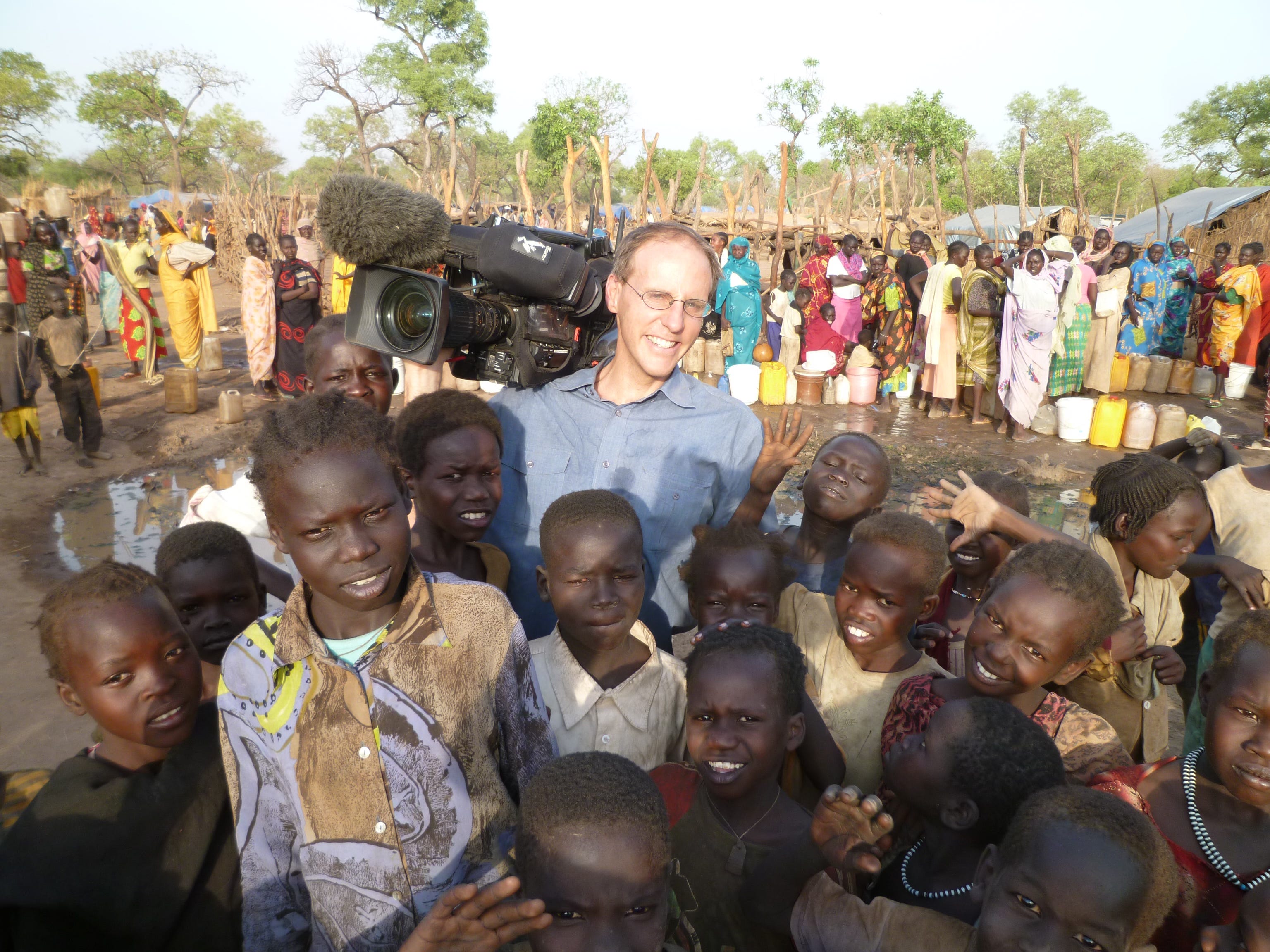
I’m Tony Smith and this is ‘People I’ve Shot’ - though more accurately this time, ‘African Livestock I’ve Shot’. Each week I take you behind-the-scenes for an insight into life on the road as a BBC journalist. This week there’s a Christmas theme.
I am in the back of a dusty Toyota Landcruiser, bumping along endless dirt roads in the middle of Africa, in search of a goat.
And not just any goat.
This is one of the more bizarre assignments of my journalistic career.
It’s 2008, coming up to Christmas, and among the leftie hummus-eating middle classes of North London sending a ‘gift’ to Africa has become all the rage. It began with a catalogue called ‘Oxfam Unwrapped’. There, the charity’s supporters can purchase and gift to a loved one. That gift is then sent, on the recipient’s behalf, to someone who needs it in the developing world. Great idea, right? Everything from farming tools and seeds to beehives and latrines are now being donated this way.
And – most famously - goats.
So Jay Hunt, then editor of the Six O’clock News (a woman practically effervescing with ideas) has casually suggested during a routine morning news meeting that the BBC should take someone who’s received such a gift to meet the actual recipient in Africa.
And that’s how I find myself barreling across Rwanda, a 15-year-old girl called Eleanor next to me, along with her mum and Brendan, an Oxfam press officer.
Eleanor is from Carlisle, not North London – but her family have been supporters of Oxfam for many years. Luckily they have home movie footage of Eleanor opening the card which revealed her Oxfam Unwrapped gift. A card with a picture of a goat – which we’re now trying to locate.
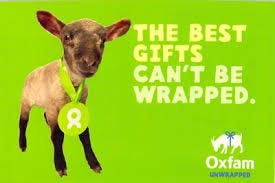
Brendan has just come from six weeks covering the horrors of the world’s largest refugee camp in Darfur. He looks exhausted and somewhat rueful when we meet in Kigali, raising a metaphorical eyebrow to this rather unusual deployment.
Clearly, the Oxfam press office back in the UK have spotted an opportunity. Six million people watch the BBC Six O’clock bulletin – that’s an awful lot of folk who might be interested in Oxfam Unwrapped. Brilliant free advertising. As long as the goat can be located.
Brendan and team have, of course, phoned ahead. The goat itself doesn’t always go to one specific family – it tends to go to a community that is being supported by various Oxfam projects. Brendan is praying that the local Oxfam team will have identified suitable interviewees – and for the purposes of the filming, a goat. We make jokes in the car about what we’ll do if the family have dined on said goat for last night’s dinner. Brendan visibly winces.
Of course, all turns out fine in the end.
After hours in the car, we arrive in Nyamikamba, where a whole host of people are waiting to greet us – many in Oxfam t-shirts. Trips with charities tend to go this way – there’s often an awful lot of handshaking and tea drinking before anything gets done. A line of well-wishers is waiting for us as we get out of the vehicle and we dutifully introduce ourselves, Brendan explaining what we’re hoping to achieve.
Eventually, we’re introduced to seventeen-year-old Celina and her family. Celina is two years older than Eleanor but tiny in comparison. They make an odd looking pair as Celina enthusiastically grabs Eleanor’s hand and propels her forward to meet the goat.
And there it is, very much alive and kicking. The money shot.
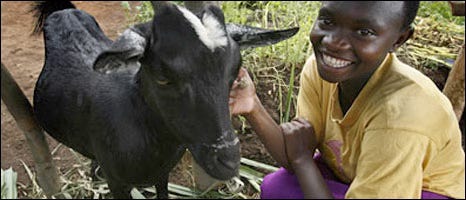
Brendan is palpably relieved.
It’s a lovely moment – I film the whole thing.
If I’m honest, the goat goes look a little scrawny. It’s definitely not the contented grazing scene I’d imagined – the dusty landscape is bone dry. But, I’m told that goat poo is good for crops – and I wonder whether that soundbite will make the edit.
Eleanor and Celina seem to take it all in their stride as I film the emotional goat reunion from all angles. Locals look on in slight bemusement – with no idea why these crazy westerners have come all this way to film one particular goat.
Celina hasn’t actually received the goat that Eleanor’s family have bought. We gloss over that. Celina’s family did receive a goat through Oxfam three years ago. They were grateful. Their original goat had several kids. One of these was sold, enabling the family to pay for a school uniform. This is all recounted to us through a translator, me filming.
“We say thank you,” says Celina.
Everyone smiles.
Especially Brendan.
We film next at the local school, where a sea of enthusiastic hands go up to answer every question and I’m practically mobbed in the dusty playground – everyone wants to be filmed. At the medical centre we’re shown facilities paid for through Oxfam Unwrapped. In the catalogue a medical check-up costs just £6 - the charity pooling these donations together until there is enough to finance a health clinic.
We say our goodbyes and I grab a few last shots as we head for home – youngsters chasing our car, screaming and waving in delight.
Back at the hotel in Kigali, we sit down in front of my laptop. This is a tricky edit – I don’t have a reporter with me and so Eleanor is going to ‘voice up’ an authored piece in the first person. She does a good job but you can appreciate it’s not easy for a 15-year-old schoolgirl to suddenly take on all the skills and experience of a television reporter, so recording her voice and getting the words right takes a long time.
In the end it’s a really good piece (if a little dated). Have a watch:
We produce a version for the children’s Newsround programme too - and I write something up for the BBC News website (the website editor rightly insists on us not focusing solely on Oxfam - other goat providers are available).
Of course, Oxfam are delighted. I wonder how many extra goats they sell that year, as a result of our report. There will have been a few, I’m sure.
And so, for many Christmases to come, I tell the story of how I travelled 4,000 miles to film a goat.
Brendan is, of course, hugely relieved (though on the journey home, we continue to joke about a village goat barbecue that evening).
As an aside, Brendan and I meet again many years later in much more tragic circumstances. He goes on to marry Jo Cox MP, who is murdered by neo-Nazi extremist Thomas Mair in 2016. I film the first interview Brendan carries out with Laura Kuenssberg – he looks so desolate and stunned, I don’t know that he even recognises me.
Eleanor and her mum are delighted too. Who knew that buying a goat in an Oxfam catalogue would lead to a BBC-funded trip to Rwanda?
I google her while researching memories for this article – and find she’s now an Assistant Film Producer with the BBC Natural History Unit.
So perhaps our trip sparked a love of travel and adventure (though I’d hope she’s now filming creatures more interesting than her Rwandan goat).
Next time: Sextortion
The next ‘People I’ve Shot’ is already underway and its the story of a very different trip to Africa – not in search of a goat, but the people behind one of the internet’s cruellest crimes. Sextortion scammers pose as women online, coaxing young teenage boys into sharing intimate images. Those images are then weaponised, with threats, shame and relentless demands for cash. Some of the victims take their own lives; few of the perpetrators ever face justice.