
Looking for Lemurs
And how a Sony walkman saved the day

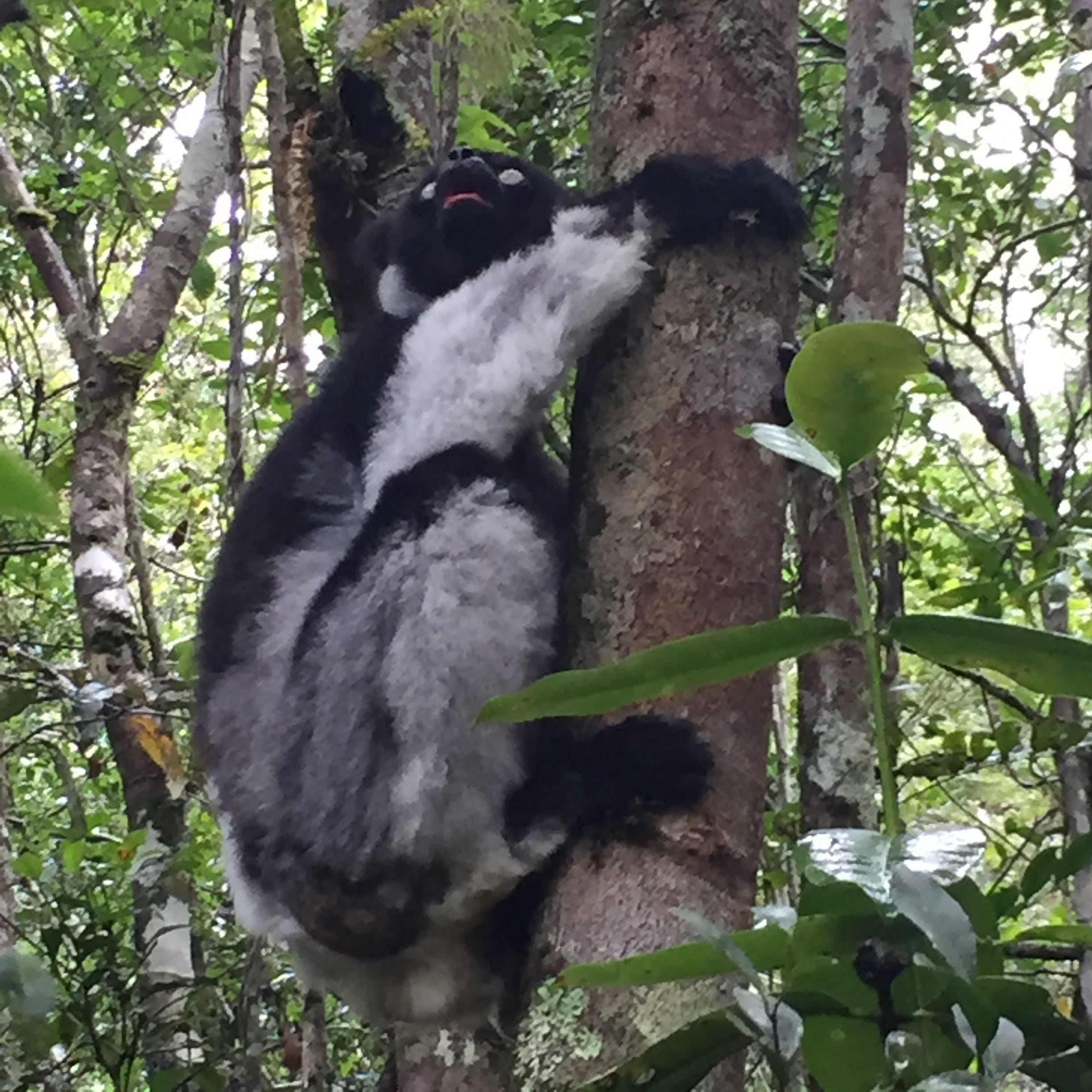
It’s been the privilege of a lifetime to work for the BBC. And no more so than on this trip - following in the footsteps of none other than the legend that is Sir David Attenborough. A story about a ‘sapphire rush’ in Madagascar. Enjoy.
I’m worried.
We’re making a film about lemurs. But we haven’t seen a single one.
We’ve been in Madagascar for four days now, haemorrhaging money. The budget for this trip is eye-wateringly high, and getting higher by the day.
And these wonderful creatures are proving to be frustratingly elusive.
We’ve heard them in the trees, unmistakeable hooting sounds coming from high in the branches. I’ve caught glimpses on the end of my lens through the thick foliage.
But have we actually seen a lemur? Not yet.
That’s a real problem if you’re making a film about lemurs.
Thankfully, we’re saved by a Sony Walkman, an old-style cassette player.
How? I’ll come to that.
I’m with friend and correspondent Angus Crawford.
Angus loves lemurs.
The project is his idea, something I remind him of occasionally as we stress about the lack of actual lemur sightings. He’s come across a story online about a “sapphire rush”. Apparently, the discovery of sapphires in a remote area of jungle has prompted a Klondike-style scramble for riches. Illicit and illegal miners are flocking to the area, tearing up the ground, decimating the countryside in one of the most important natural habitats of the Indri lemur.
Conservationists are deeply concerned.
The species itself is threatened.
At least that’s what Angus optimistically writes up for our monthly commissioning meeting. Stories tend to be somewhat “oversold” at such meetings. To our surprise, editors give it the nod.
Angus sets about planning from London.
We know we’ll need to trek into the jungle where sapphire mining is taking place. It’s a day’s hike just to get there. It’s remote and potentially dangerous, so the logistics are challenging, so much so that we’ve been advised to take along a BBC safety advisor.
Thus Sally joins the team, marching us straight off to safety stores to stock up on mosquito repellent, water purification and camping supplies. Sally turns out to be the kind of no-nonsense, practical ex-army type essential for this kind of expedition. It helps that she’s married to a serving SAS officer.
We’ve been commissioned to make a half-hour documentary as well as pieces for TV, radio and the website. I’m now feeling slightly daunted by the amount of material I’ll need to gather in the very small amount of time we’ll have on the ground among the sapphire miners.
So, unusually for me, I ask for help.
Thus Chris joins the team as second camera operator, a Brit currently working in the BBC’s South Africa bureau. He’ll take on some drone filming and provide a second camera when I need help.
Making some calls from London, we identify a brilliant local fixer who seems to know everyone in the area of Madagascar we’ll be travelling to. She advises us that we’ll need local porters, local guides, and an escort from the local police.
You can see now how that budget has spiralled.
After many weeks of planning, Angus, Sally and I fly to Madagascar’s capital, Antananarivo, where we spend one night in a luxury hotel. This is the last we’ll see of luxury for a while. Over a beer, we catch up with Chris, who has flown in from Johannesburg. Our fixer Ange joins us and we make a plan to leave early the next morning.
Sun up and we load the considerable number of kit bags that Sally has brought along into a sturdy-looking Toyota LandCruiser and head off. Our destination is the town of Toamasina, the jumping-off point for our trek into the jungle, an entire day’s drive away. It’s getting dark by the time we arrive, only to find that the hotel Ange has booked us into is locked and boarded up, having apparently shut down.
We spend another hour driving round this ramshackle town trying to find alternative lodgings. There’s one place which can only be described as a bit of a flea pit. It’s the only option, so we take filthy rooms and try to get some sleep.
Sally has us all up at dawn checking kit, while Ange hustles round town making arrangements and buying supplies. Angus, Chris and I are all feeling somewhat apprehensive. We drive as far as we can down bumpy, unmade tracks, arriving at a ramshackle settlement from where we’ll go on foot. Ange has somehow already arranged guides and porters who set about loading our bags of kit onto their backs. Next, we visit a police post where two ragged-looking gendarmes are waiting to accompany us, both toting rusty AK47s.
And we set off.
It’s hot, humid and tough going, but we’re in good spirits at first.
And then we hit mud.
It’s the rainy season and the paths soon turn to a russet-brown quagmire.
It makes walking hard going. Within an hour or two, my boots are caked in thick claggy mud, squelching with every footstep. Another hour later and my socks are saturated.
The porters stride past us comfortably, some barefoot, some in brightly-coloured plastic jelly shoes.
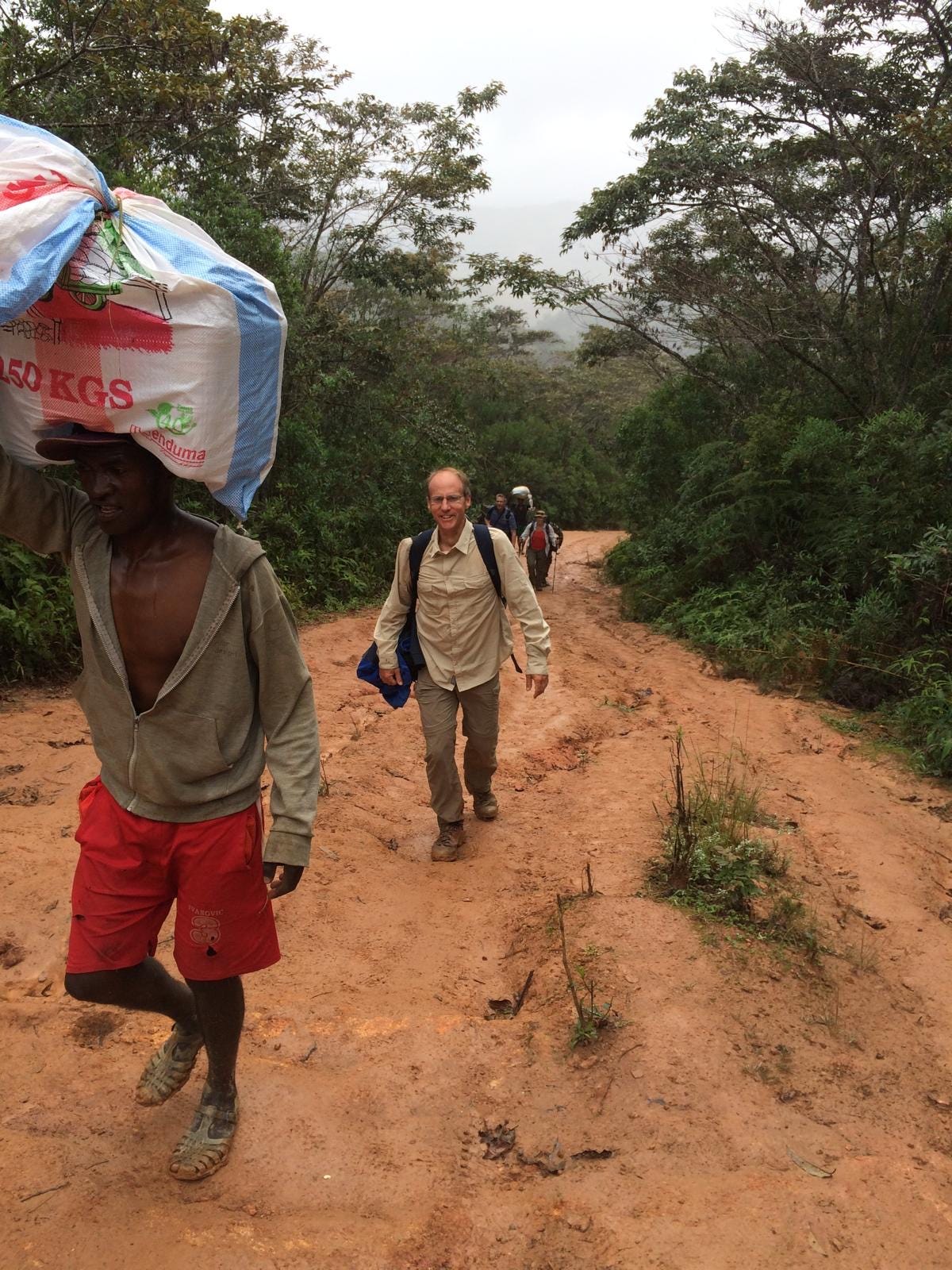
We’re all exhausted.
We take a break at a small settlement, a tea station, which Ange says is about halfway. Sally fuels us up with energy bars.
We set off again, Angus and I deciding to ditch our boots in favour of sandals.
Sandals and socks is never a good look. Wet and covered in mud, it’s even worse, but at least we’re more comfortable. Chris struggles on in mud-covered boots, getting heavier by the mile. I’m feeling quietly relieved that I’m coping while Chris, who’s ten years younger than Angus and I, is finding it hard going.
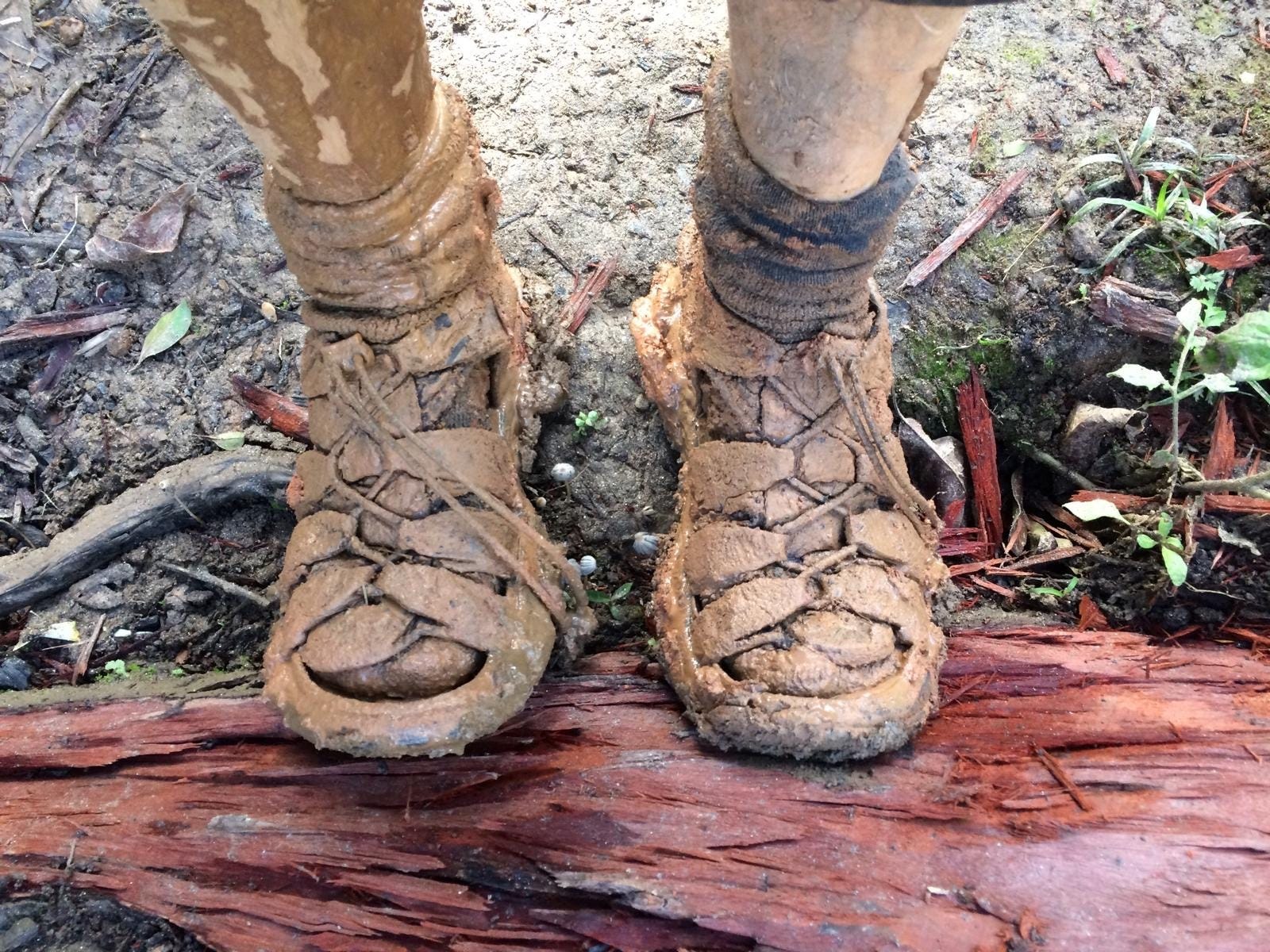
I don’t think I have ever sweated so much, before or since.
Sally, of course, is on top of everything and dishes out water to the team at regular intervals. I also try to get some shots of our journey, acutely conscious that my camera gear is getting covered in mud, sweat, dust and dirt.
The path winds through thick jungle with very little sign of human life, aside from the occasional group of ragged-looking miners walking back in the opposite direction. We roll trousers up to wade through streams, picking leeches from our legs.
There are a lot of leeches.
Midway through the afternoon the guide halts us, pointing excitedly.
For a second I think it’s another of Sally’s water breaks, but there’s something else going on: a distant rustling in the treetops above and then the howl of our first lemur. I try to film but it’s virtually impossible, the animal is on the move through the trees and impossible to pinpoint. But we’ve heard a lemur, and that renews our enthusiasm for the story. Angus is a bundle of excitement. It’s the boost we need to complete this journey and within an hour we find ourselves arriving at the sapphire mine.
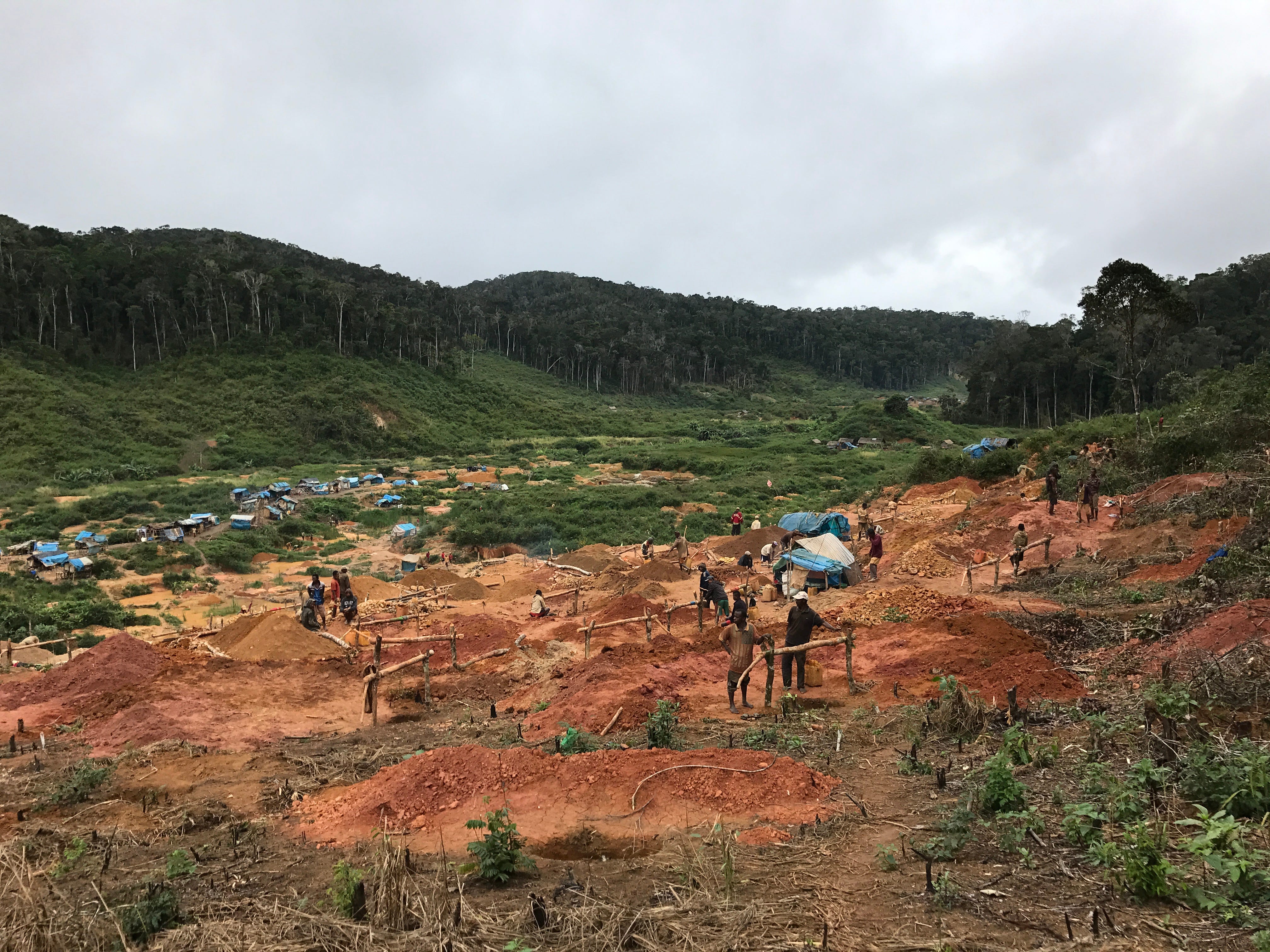
It’s an extraordinary sight: a vast area of hollowed-out forest, the landscape of dirty red earth pockmarked with man-made holes as far as the eye can see. It looks something like the surface of the moon, but a hive of activity, with many of the holes filled with men at work, digging, excavating, hunting for gems.
We’ve had no way of alerting people here to our imminent arrival and we honestly don’t know how we’ll be received. Word soon gets round, via our guides, that we’re a visiting film crew. There’s curiosity, some smiles, but mostly the miners just continue to go about their business, totally unfussed and unfazed by our presence. I’m pleasantly surprised. It looks like our gun-toting gendarmes won’t be needed as protection. Not that they would have been much use anyway, both have by now ambled off to get food.
As the sun sets, Chris and I start some tentative filming, golden hour on a Wild West lawless landscape of sapphire excavation.
Sally, ever on the ball, sets about organising our encampment, unpacking bags, giving us instructions on tent pitching. She’s brought a spade with which to dig a hole for our latrine.
We’re all being super careful with what we eat, sticking to the boil-in-the-bag ready meals that we’ve brought all the way from London. No one wants to get sick and use that latrine more than is absolutely necessary. In fact, no one really wants to use it at all.
We have dinner around a campfire, exhausted. Angus is a little worried about our return hike having the makings of a couple of blisters. Sally dives into the first aid kit, tending his feet with emery paper and cutting his toenails. It’s a pedicure, but not as we know it.
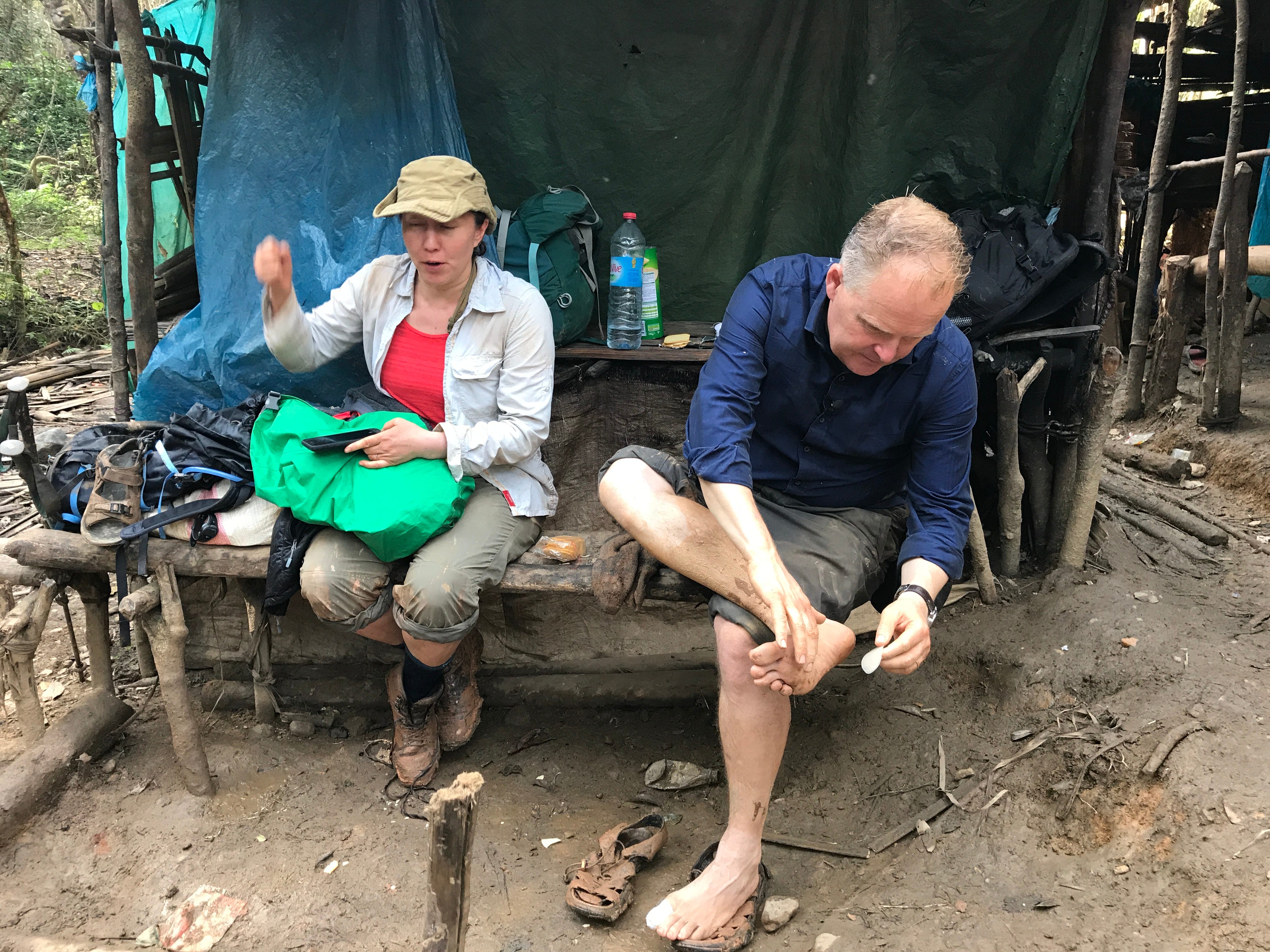
We all sleep, and sleep well.
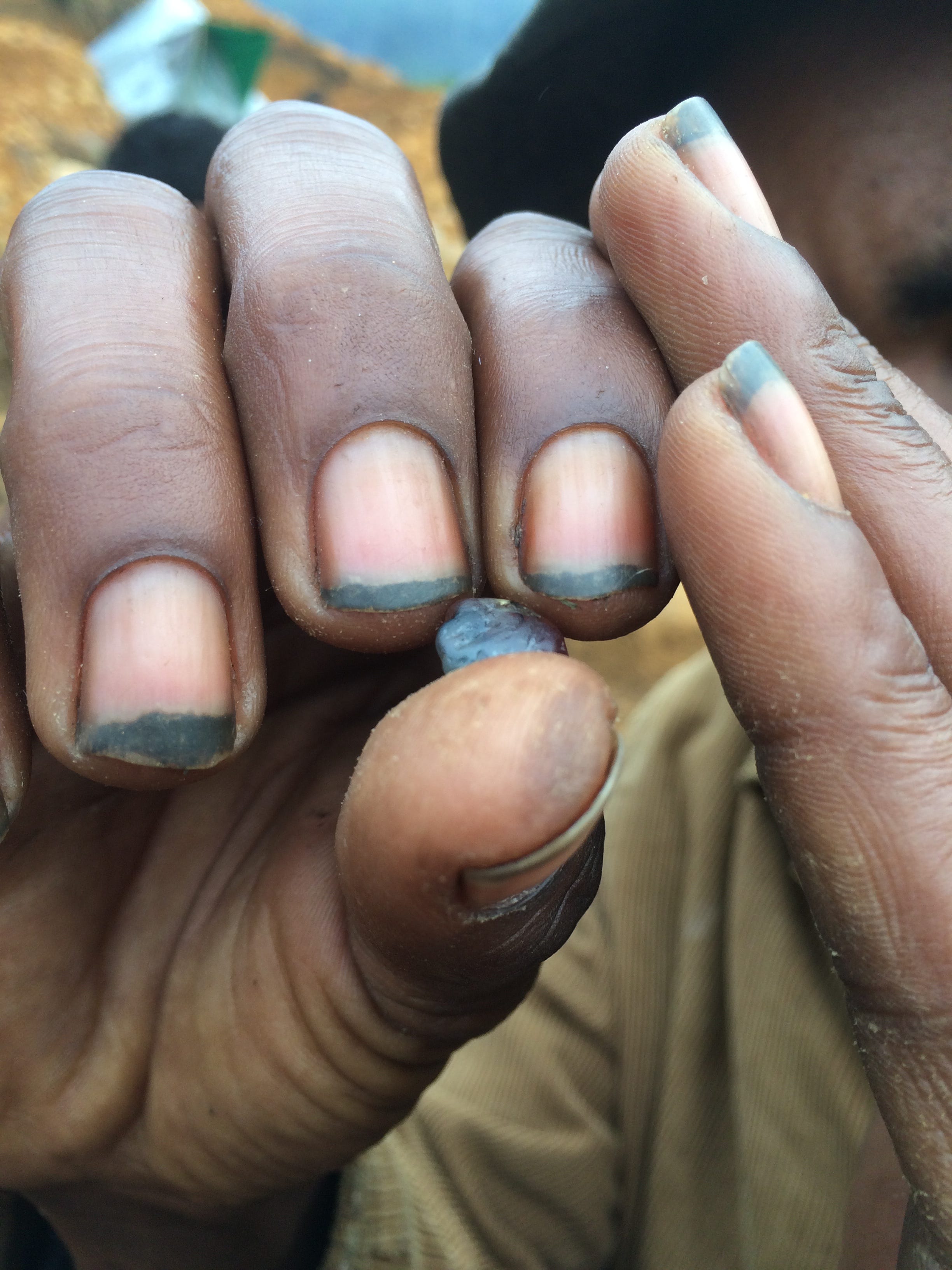
Day three is spent filming and it’s one of those days, as a cameraman, where everything falls into place. We have a drone up over this dramatic landscape. We have a GoPro down one of the miners’ tunnels. We have dirt-covered miners showing us the sapphires they’ve unearthed thus far. And to top it off, we hear the distinctive cry of a pack of lemurs in the distant forest, allowing Angus a magical piece-to-camera where he looks genuinely thrilled.
There’s a saying in camerawork: “shoot the shit out of it”.
Chris and I do just that for the whole day.
There’s a makeshift market where stalls have been erected, prefab structures covered in tarpaulin selling meat, beer, tools and torches. There we interview some of the miners, each of them clinging to a dream of getting rich with that one breakthrough find.
By nightfall we have pretty much everything we need in that one day’s filming. Our batteries are nearly dead, and we have no way of charging them.
We have everything, that is, except lemurs.
I’m beginning to get a little antsy about this, telling Angus, “you can’t have a film about lemurs without seeing a lemur”.
Realistically, we’ve always known that spotting one here would be difficult. Our story is the fact that the lemurs themselves are threatened and losing habitat to the miners, so they’re unlikely to be lounging around on the edge of the mine itself.
But it’s becoming something of a worry.
The BBC’s Natural History Unit has a well-deserved reputation for spending months making world-class wildlife documentaries.
After everything we went through on this trip, I now have huge respect for everything their camera teams endure. We did just a few days, those guys cope in these conditions for months on end. Hats off to them.
But Angus isn’t David Attenborough.
And we have only a few days.
Ange has a plan. A protected lemur sanctuary exists on the outskirts of Toamasina where wild lemurs are easier to spot. But first we need to make the return journey on foot.
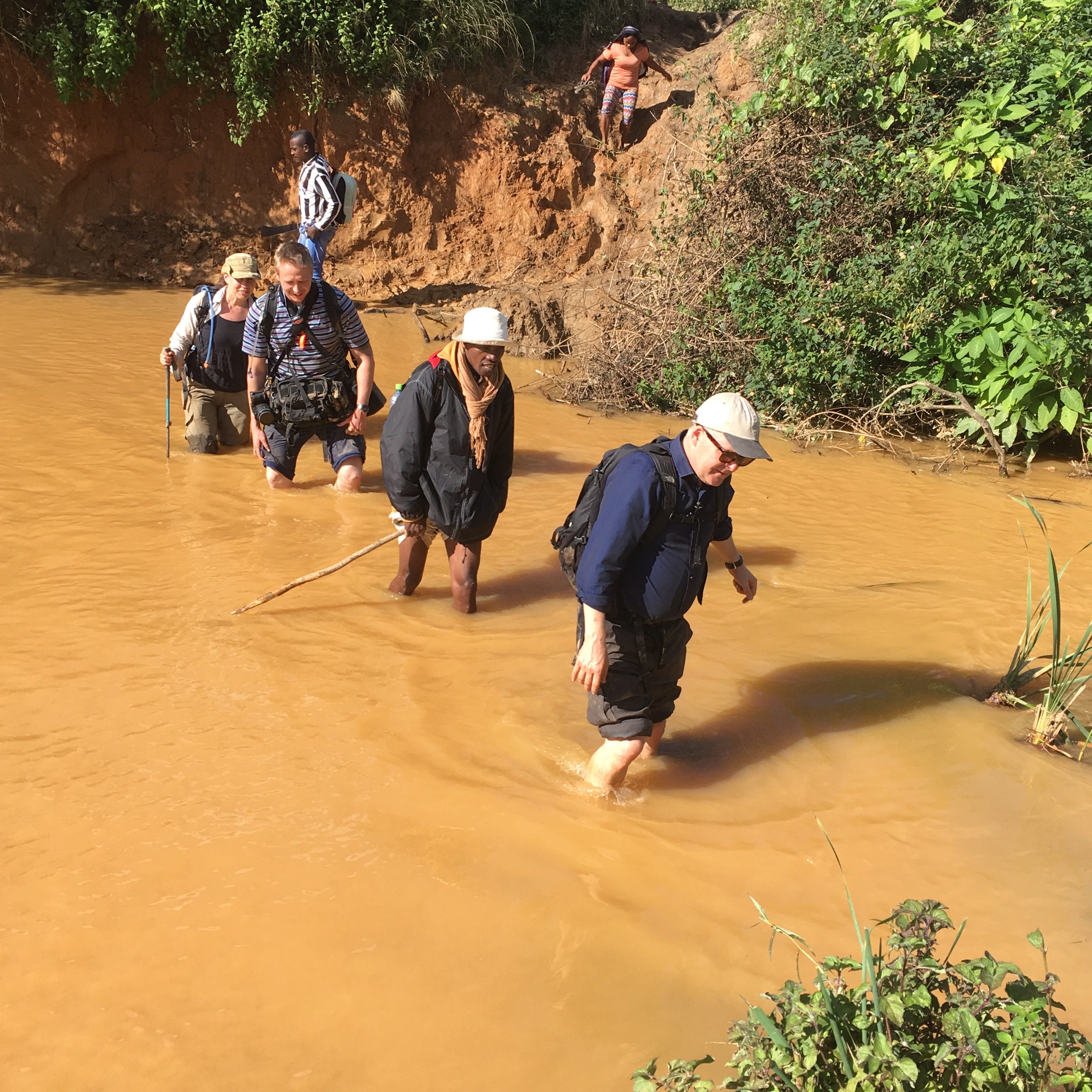
It’s even harder going back, but we trudge onward through the mud. Again, we hear lemurs in the trees, but this time we’re less excited, focusing just on getting back to civilisation. At the end of the day’s walk we break into a slightly deranged ecstatic run down the final hill, the streets of Toamasina finally in sight. We say goodbye to our gendarmes, paying them handsomely for their time, and head for the hotel.
A beer has never tasted so good.
But yes, I’m still worried. We still haven’t actually seen a lemur. Angus and Ange are relaxed. We’ll see them at the wildlife sanctuary the next day. I’m not so sure.
We set out next morning for Mitsinjo, a protected area of trails and forest that has welcomed journalists and film crews for several years. Again, it’s hot and humid, but we all know we’ve done the toughest part of the shoot and come away with some stunning images. We just need to see some bloody lemurs.
Walking the trails of Mitsinjo, we catch the odd sighting in the trees above. It’s good, but still difficult to film. The occasional glimpse. Nothing more. Angus now also appears a little concerned.
“Can we get any nearer to them?” we ask a local guide.
He pulls out a battered old Sony Walkman, with a speaker attached to the headphone jack.
Angus and I look confused.
He presses play.
The cassette whirs into action, emitting the unmistakeable sound of a lemur’s cry.
And the lemurs here call back, a loud, piercing hoot that punctures the silence.
The guide smiles.
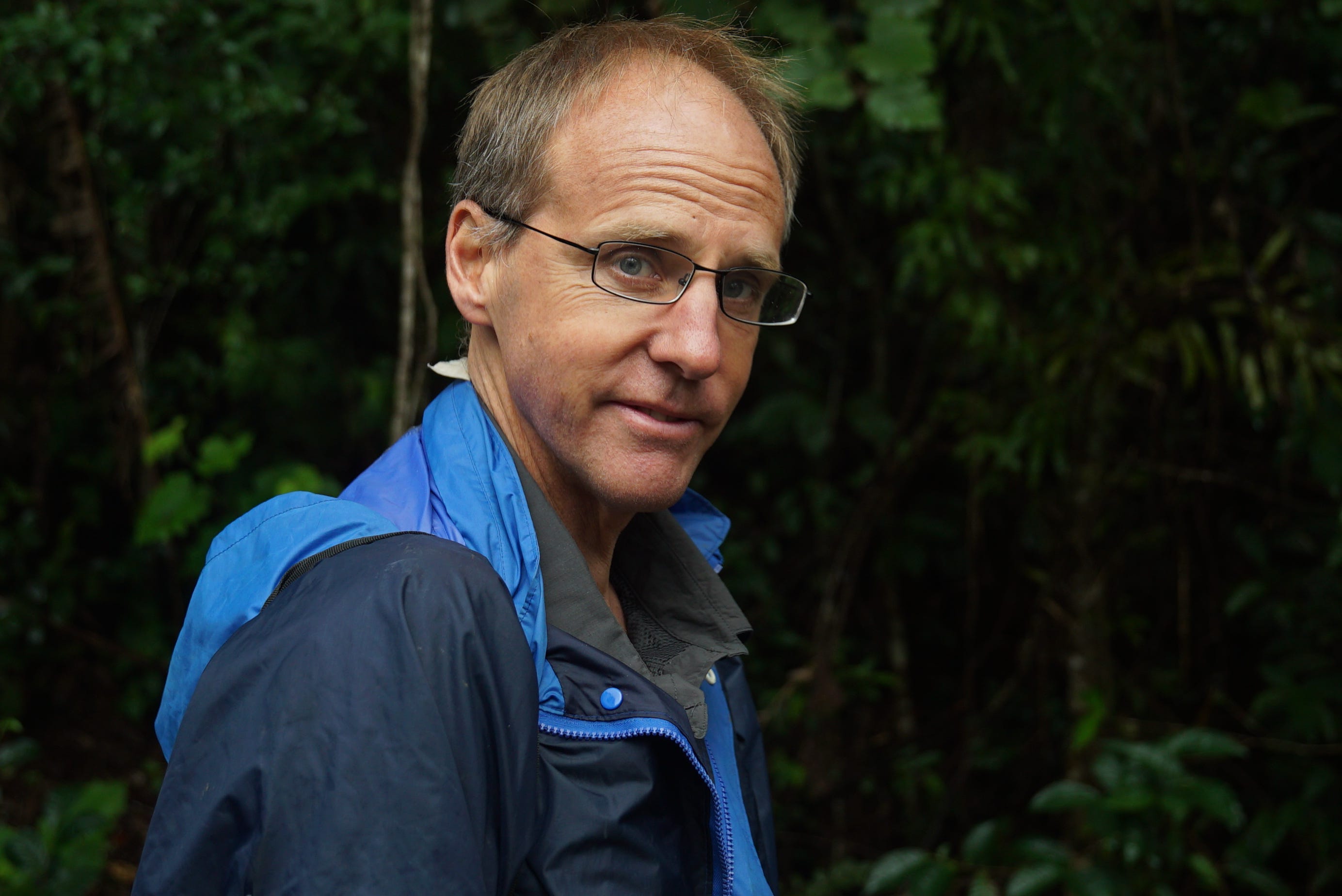
Above us, branches rustle, the lemurs come closer.
One, in particular, seems especially confident, climbing down ever closer.
And a few moments later it is perched in the tree above us, easy to film.
Angus grins.
The guide tells us that this particular lemur is called David, named after David Attenborough, who also filmed here many years ago.
We are working amid television royalty.
David, it seems, is something of a star, the lemur, not the BBC legend.
We learn later that David has been filmed by pretty much every camera crew that has ever passed through Madagascar, including our own colleague, the BBC’s Environment Editor David Shukman, who had been here a few years previously, focusing on species extinction rather than sapphire mining.
And so we head back to the capital, relieved to have everything we need. There’s some filming to be done in a gem merchant and interviews with environmental experts, but this is all a breeze compared to the mud and the leeches.
The film goes down well with our bosses, but there are probably some raised eyebrows when expenses claims are finally submitted and totalled up.
One postscript.
A few years later we’re back in touch with one of the scientists we’d interviewed, one of those who’d said that the Indri lemur “could be threatened with extinction” because of this lawless sapphire rush.
Well, apparently, the Indri rather liked the sapphire miners.
Her latest research paper reveals the surprising news that deforestation in the sapphire-rich area had turned out to be “lower than expected”. And the lemur population is “overall relatively healthy”.
So the lemurs are thriving. Including David, I hope. I’m glad. Our story may have turned out to be journalistically a little flawed. But no matter. It gave us the adventure of a lifetime.